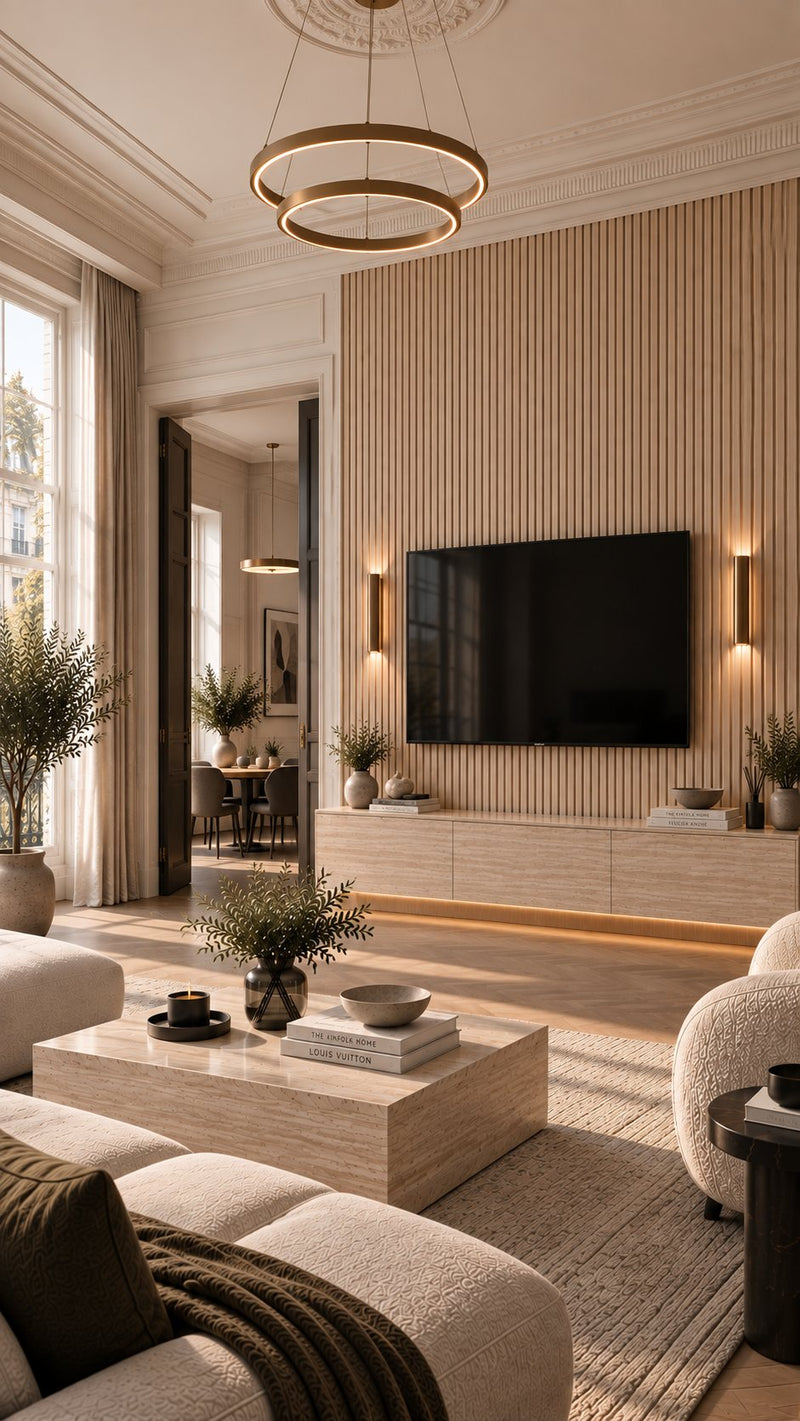
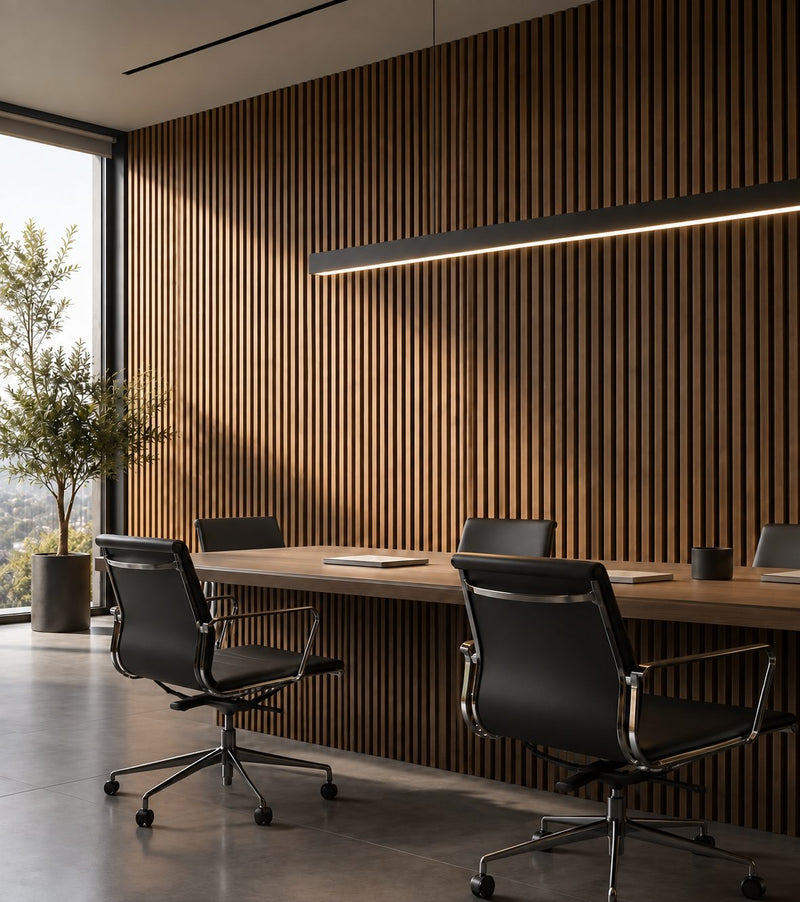
A slat wall panel is made of vertical timber-look slats fixed to a backing board. You will see the same product sold under several names: acoustic slat panels when the backing is felt, wood slat panelling or wall cladding when the core is MDF or polymer, and occasionally fluted panels. This guide explains the two main types, which rooms suit each one and what to check before you order.
What do slat wall panels actually do?
The gaps between the slats break up the light, so even a single-colour wall gains depth and changes character through the day. On felt-backed panels the same gaps let sound reach the felt, which absorbs part of it and shortens the echo in the room. Decorative slat panelling makes no acoustic claim; its job is a fast, clean change to the look of a wall.
Acoustic slat panels vs wood slat panelling
Both give a vertical slatted finish, but they are built differently and solve different problems.
Acoustic slat wall panels
E-board acoustic wall panels are 6 mm MDF slats mounted on 3 mm high-density acoustic felt, 9 mm thick overall, in a standard 600 x 2400 mm size. The felt absorbs sound passing between the slats. They are the natural choice for meeting rooms, home offices, cafés, bedrooms and open-plan living spaces where echo is a problem.
Wood slat wall panelling
Our wood slat wall panels measure 135 x 2800 mm and come in boxes of six. They interlock, so they go up quickly, and they are used purely for visual impact on TV walls, hallways, entrances and headboard walls. The soft touch range has a smooth matt surface that resists fingerprints.
A simple rule: if the room echoes or feels noisy, choose acoustic panels. If you only want a new look, wood slat panelling does the job.
Which room suits which panel?
- Living room and TV wall: either type. In a large room with hard floors and little soft furnishing, acoustic panels make a noticeable difference.
- Bedroom: acoustic panels behind the bed add warmth and a calmer sound.
- Home office and meeting room: acoustic panels, which cut the echo that makes video calls tiring.
- Cafés, restaurants and shops: acoustic panels, with a wipeable face that copes with heavy use.
- Bathrooms and kitchen splashbacks: use PVC wall panels instead. MDF-based panels are not suitable for surfaces that get wet.
How to choose a colour and finish
The range falls into three groups. Wood finishes (Natural Oak, Anatolian Walnut, Noce Marino, Seoul, Board Teak, Antique) feel warm and classic. Stone finishes (Travertine, Rock, Light Grey Stone, Dark Grey Stone) give a mineral, contemporary look. Solid colours (Anthracite, Black, Beige, White, Sand Grey, Storm Grey) keep a minimal scheme and let the furniture lead.
Colours on screen never match real light exactly. Order a sample and look at it in the room itself, once in daylight and once in the evening, before you commit.
How long does installation take?
Both types are bonded with silicone or panel adhesive to a flat, clean, dry wall. A TV wall of roughly 3 x 2.5 m takes two people about half a day. Our step-by-step installation guide covers the process, and the adhesive guide explains which product to use on which wall.
What affects the price?
Three things: the panel type (felt-backed acoustic panels cost more than decorative slat panelling), the area you need to cover and the size of the project. On commercial jobs such as hotels, offices and schools, the unit price falls as the area grows. Use our panel quantity guide to work out how many you need, or contact us for a project quote.
How to judge panel quality
Two panels can look identical in a photo, but a few details give the quality away. Look at the edges of the slats first: if the wrap or veneer is lifting at the corners, it will open up further with changes in humidity. Check where the slats meet the felt; slats that flex or leave gaps will be hard to line up on the wall. Felt density matters too. Thin felt that collapses under your thumb absorbs less sound and tears more easily during fitting. That is why E-board acoustic panels use a 3 mm high-density felt, chosen for both absorption and durability.
Think about the surface finish in terms of use. Matt and soft touch finishes do not show fingerprints, which suits children's rooms and busy spaces. Grained wood finishes suit a natural scheme, while finishes with a slight sheen bounce light around small or dark rooms.
Full wall or part of the wall?
Slat panelling does not have to cover a wall from end to end. There are three common approaches. A full wall gives the strongest look and, acoustically, the best result. A vertical feature strip, for example a 1200 to 1800 mm wide block of panels behind the TV with painted wall either side, frames a focal point. Half-height panelling runs from the floor to around 1000 to 1200 mm with paint above, which keeps costs down and protects the lower wall from knocks in hallways and children's rooms.
Whichever you choose, finish the panels against a trim or a natural line such as a corner or the ceiling. A panel that simply stops in the middle of a wall can look unfinished.
Using slat panels with lighting
The way slats interact with light is what makes them so popular. A ceiling spot that washes down the wall, or an LED strip hidden along the top edge, lengthens the shadows between the slats and exaggerates the depth. Light from slightly above and to the side shows this off far better than light straight on. If you plan wall lights, run the cable before fitting and bring it out between two slats.
Frequently asked questions
Do slat panels soundproof a room?
Acoustic panels reduce echo inside the room, but they will not stop sound coming through from next door. We explain the difference between absorption and soundproofing in a separate article.
Can the panels be removed later?
Panels fixed with adhesive can be taken down, but the wall will need making good and repainting. If you rent, fix the panels to thin timber battens and screw the battens to the wall, which makes removal much easier.
Can I get a sample?
Yes. We post samples of any colour, and every finish is on display at our store in New Southgate, London.