Anyone looking for an alternative to tiles in a bathroom or kitchen tends to ask the same thing first: will PVC wall panels actually hold up in a wet room? With the right product and a careful installation they will, and they get rid of grout cleaning altogether. This guide covers where PVC panels work, where they need care and what to check when fitting them.
Can you use PVC wall panels in a bathroom?
Yes. PVC does not absorb water, will not rot and does not swell with moisture. It suits shower surrounds, the wall beside the bath, splashbacks behind basins and toilet walls. E-board PVC wall panels are large 1220 x 2440 mm sheets, so most walls are covered with two or three sheets and very few joints. Fewer joints means fewer places for water to get in.
The detail that matters is the joints. Seal the joints between sheets, the junction with the shower tray or bath, and the corners with neutral-cure sanitary silicone.
Can PVC panels be used as a kitchen splashback?
Yes, and it is one of the most popular uses. Grease and splashes wipe off, and there is no grout to discolour. The one limit is heat: PVC is not heat resistant. Behind a hob, use a glass or stainless steel upstand where the surface meets direct heat, or keep the clearance between hob and panel that the hob manufacturer recommends.
PVC panels vs tiles
- Fitting time: a bathroom wall in PVC is finished the same day. Tiling, grouting and drying take several days.
- Cleaning: no grout lines on PVC, just a wipe. Grout darkens over time.
- Refurbishment: PVC panels can go straight over existing tiles, with no removal.
- Durability: tiles resist scratches and heat better; PVC is more vulnerable to sharp knocks.
- Floors: PVC wall panels are for walls only, never floors.
Can PVC panels go over existing tiles?
Yes, as long as the tiles are sound, flat and clean. Degrease the surface and fix any loose or cracked tiles first. If the grout lines are deep, apply adhesive in generous dabs rather than thin beads so it makes full contact. Our adhesive guide explains which product to use.
Which pattern suits which bathroom?
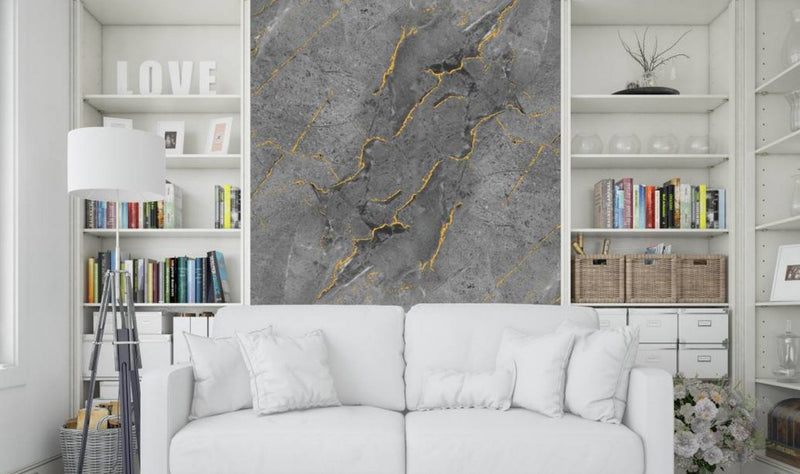
In a small bathroom, white-based patterns with fine veining make the room feel bigger: Bianco Carrara and Gild Fish Belly White are good examples. For a bolder look, the dark Black White or the gold-veined Kata Jinyan make a strong statement. Read our marble effect PVC panel guide for more on choosing a pattern.
How to fit PVC panels in a bathroom
- Prepare the surface. The wall or existing tiles must be clean, dry and free of grease. If there is mould, treat it and let the wall dry out completely.
- Measure and cut the sheet. Cut the 1220 x 2440 mm sheet with a fine-tooth saw or circular saw. Marking the cut line on masking tape stops the face from scratching.
- Cut holes for the fittings. Transfer the positions of taps and shower outlets to the sheet using a card template, then cut the holes with a hole saw or jigsaw.
- Apply the adhesive. Use a solvent-free panel adhesive in dabs or vertical beads on the back of the sheet.
- Fit the sheet. Rest the sheet on the wall from the bottom up and press it on from the centre outwards with a roller or clean cloth so no air is trapped.
- Seal the joints. Fill the joints between sheets, the corners and the bottom edge where it meets the tray or bath with neutral-cure sanitary silicone, and smooth it with a wet finger or a tool.
Why ventilation matters
PVC itself is waterproof, but in a badly ventilated bathroom the risk is to the wall behind it. Water getting past a failed joint, or condensation, can cause mould on the wall over time. Make sure the extractor fan works properly and check the silicone joints once a year. Replacing blackened or lifting silicone takes minutes and extends the life of the installation.
Extra points for kitchens
On a splashback, the bottom edge of the panel meets the worktop and the top edge meets the wall units. Seal both with silicone. Where there are sockets, refit the faceplates with an extension box after cutting. Plan a heat-resistant section behind the hob. To balance the marble pattern with the units, pick a light-based pattern if the cabinets are dark, or a more strongly veined pattern if the cabinets are white.
The cost picture
The total cost of PVC panelling usually comes in below tiling, because the saving is not just in materials. There is no stripping out, no rubble, no grout, far less labour and no week without a usable bathroom. In rental properties and hotel rooms that need a quick turnaround, the difference is even bigger. Contact us for project pricing.
Why PVC panel thickness matters
Very thin PVC sheets and thicker rigid panels are often sold under the same name. Thin sheets show every bump in the wall, look wavy when light falls across them and dent easily. E-board marble effect PVC panels are 2.7 mm thick, which keeps the face flat and rigid and hides small imperfections in the wall. Check the thickness on the product page before you buy, and if you can, hold a sample and feel how much it flexes. Thickness and surface quality show most on wide walls and in bathrooms where light rakes across the surface.
Frequently asked questions
Can PVC panels go inside a shower?
Yes, on the shower walls. Seal every joint and the top edge of the tray with silicone.
Do PVC panels turn yellow?
Indoors, away from direct sun and heat, they keep their colour. Surfaces in strong direct sunlight for long periods may change colour.
How do you clean them?
Warm water and a mild detergent are enough. Avoid scouring pads and solvent-based cleaners.